Best AI Model in June 2026: Top LLMs Ranked & Compared
The best AI model in June 2026 is Claude Opus 4.8 (Intelligence Index 61.4), ahead of GPT-5.5, Gemini 3.1 Pro & Grok 4.3. Full ranking, pricing & use cases.

Best AI Model in June 2026: The Top LLMs Ranked, Compared, and Explained
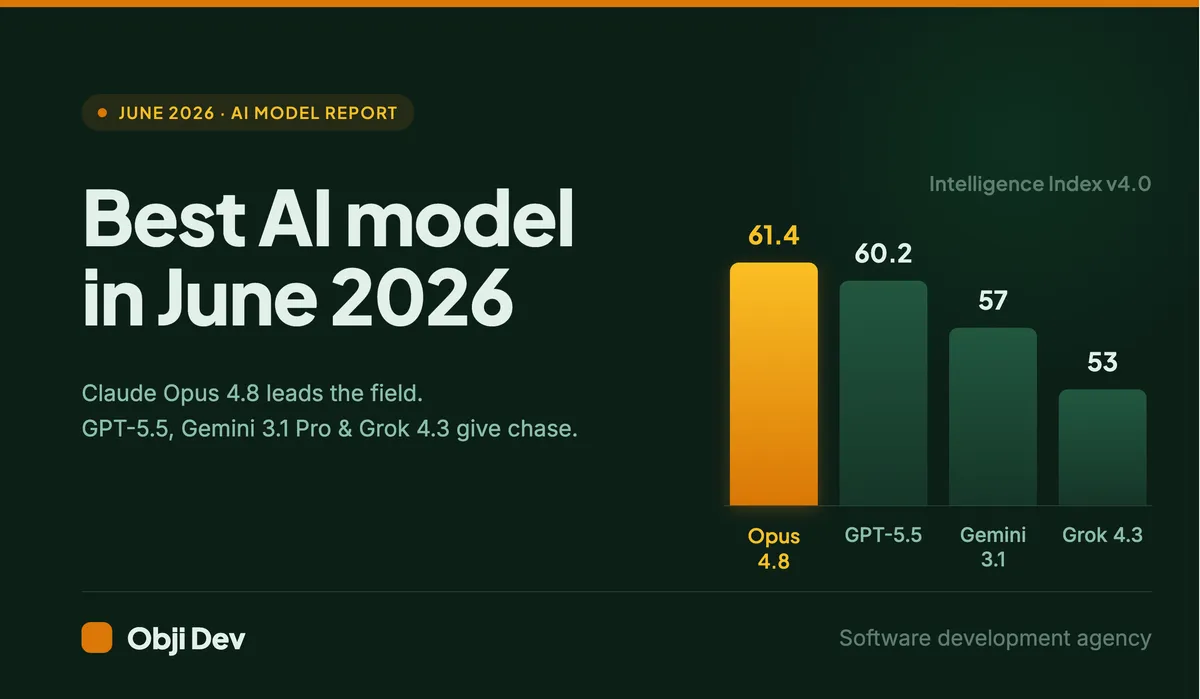
Quick answer: As of June 2026, the best overall AI model is Claude Opus 4.8, which leads the Artificial Analysis Intelligence Index v4.0 with a score of 61.4 — the first model to cross 60 by a clear margin. It is followed by GPT-5.5 (60.2), Gemini 3.1 Pro (57), and Grok 4.3 (53). There is no single winner for every job, though: Opus 4.8 leads overall intelligence and coding, Gemini 3.1 Pro wins multimodal and value, GPT-5.5 leads creative writing and everyday chat, and Grok 4.3 is the budget pick among the big four. For open-weight models, Kimi K2.6 (53.9) sits at the top.
If you only remember one thing: "best" depends entirely on your workload and budget. The rest of this guide shows you exactly which model fits which job — and how to actually put it to work inside a product.
The June 2026 AI model leaderboard at a glance
The single most-cited benchmark right now is the Artificial Analysis Intelligence Index v4.0, a composite score that aggregates ten evaluations spanning reasoning, coding, agentic tool use, science, and long-context retrieval. Here is where the frontier stands this month.
RankModelMakerIntelligence IndexAPI price (in / out per 1M tokens)Context windowBest at1Claude Opus 4.8Anthropic61.4$5 / $251MOverall intelligence, coding2GPT-5.5OpenAI60.2~$5 / $301MCreative writing, everyday chat, agentic work3Gemini 3.1 ProGoogle57$2 / $121MMultimodal, reasoning, value4Grok 4.3xAI53~$3 / $15largeReal-time data, budget agentic—Kimi K2.6 (open)Moonshot AI53.9self-host262KTop open-weight coding—DeepSeek V4-Pro (open)DeepSeek51.5self-host1MBest cost-per-intelligence
Prices reflect publicly reported June 2026 rates and shift frequently — always verify current pricing before committing a production budget.
A few patterns are worth reading in that table. First, the top tier is now a genuine three-way race between Anthropic, OpenAI, and Google, with the gap from #1 to #3 narrower than it has been in over a year. Second, open-weight models from Chinese labs have closed in fast — eight of the ten leading open models now come from Chinese companies. Third, price and intelligence no longer move together: the most expensive model is not the smartest per dollar, which is exactly why model selection has become an engineering decision rather than a brand-loyalty one.
What is the best AI model right now? (Direct answer)
The best AI model overall in June 2026 is Claude Opus 4.8, released by Anthropic on May 28, 2026. It became the first model to break above 60 on the Intelligence Index, and by early June it had also retaken the top spot on GDPval-AA — a benchmark that measures performance on real-world, economically valuable tasks — with an Elo of roughly 1,890, well ahead of GPT-5.5 in second place.
But "best overall" is a headline, not a recommendation. The honest answer most teams need is: best for what? The sections below break it down by job.
Best AI model by use case
Best for coding and software engineering: Claude Opus 4.8 (GPT-5.5 close behind)
Opus 4.8 is the strongest coding model publicly available, posting a roughly 69% score on SWE-bench Pro — a large jump over the previous Opus generation. In practice, that gap matters more than the raw number: on autonomous coding workloads, fewer failed runs mean less human babysitting, so the per-task cost can actually be lower even when the per-token price is higher. GPT-5.5 is genuinely neck-and-neck here and is many engineers' default for tool use and long-horizon agent tasks.
For teams running repository-scale work — large migrations, multi-file refactors, long-running agents — Anthropic also released Claude Fable 5 on June 9, 2026, its first "Mythos-class" model. It sits above Opus 4.8, carries a context window beyond one million tokens, and is priced at a premium ($10 / $50 per million tokens). It is overkill for everyday tasks but compelling when reliability across a huge codebase reduces expensive retries.
Best for multimodal, reasoning, and value: Gemini 3.1 Pro
Gemini 3.1 Pro is the value champion of the top tier at $2 / $12 per million tokens — less than half the output cost of Opus 4.8 — while leading on multimodal understanding (including native video), long-context retrieval, and scientific reasoning. If you are already inside the Google ecosystem, or you are processing large volumes of mixed text, image, and video, this is usually the rational default.
Best for writing and everyday assistant work: GPT-5.5
GPT-5.5, released in April 2026, remains the leader for creative and structured writing and is the default model behind ChatGPT for daily assistant use. It pairs strong agentic capability with the broadest general-purpose polish of the four flagships, which is why it is still the safest "one model for everything" pick for non-technical teams.
Best budget and real-time pick: Grok 4.3
Grok 4.3 is the cheapest of the big four to run and brings unique real-time access to data from X, making it strong for social monitoring, trend research, and cost-sensitive agentic workloads. Its most powerful features sit behind higher-priced subscription tiers, so check what you actually get at your plan level.
Best open-weight models: Kimi K2.6 and DeepSeek V4-Pro
If you need to self-host for privacy, control, or cost reasons, Kimi K2.6 from Moonshot AI tops the open-source ranking at 53.9 and has impressed enterprises with sustained agentic performance — in one reported case autonomously refactoring an eight-year-old financial engine over 13 hours with more than 1,000 tool calls. DeepSeek V4-Pro offers the best raw cost-per-intelligence on the board. NVIDIA also entered the conversation on June 4 with Nemotron 3 Ultra, a 550-billion-parameter model under a fully permissive license.
How to actually choose: a decision framework
Picking a model is no longer about chasing the top of a leaderboard. The leaderboard changes monthly; your constraints don't. Work through these four questions instead:
- What is the core task? Coding and agents → Opus 4.8 or GPT-5.5. Multimodal or high-volume analysis → Gemini 3.1 Pro. Writing and general chat → GPT-5.5. Privacy-sensitive or cost-capped at scale → an open-weight model.
- What is your cost ceiling per request? A 2.5x price difference on output tokens compounds fast across millions of calls. Model the spend on your real traffic, not on a benchmark.
- How much reliability do you need? For autonomous workflows, a smarter model that fails less often is frequently cheaper end-to-end than a cheap model that needs human cleanup.
- Should you route, not pick? The most sophisticated teams no longer choose one model. They route each request to the cheapest model that can handle it, escalating only hard queries to a frontier model. This single architectural decision often cuts AI costs by more than half.
That last point is where most companies leave money — and quality — on the table. And it's where having an experienced build partner pays for itself.
Turning the "best model" into a working product — with Obji Dev
Knowing that Opus 4.8 tops the index is the easy part. The hard part is everything after: choosing the right model for your workload, wiring it into your stack, controlling token costs, handling failures gracefully, and shipping something users actually trust. A benchmark score doesn't write your prompt logic, build your evaluation harness, or set up model routing.
That is exactly the gap Obji Dev fills. As a software development agency, Obji Dev helps companies move from "we should use AI" to a production system that works — without burning months on trial and error or locking themselves into the wrong model. Typical engagements include:
- Model selection and benchmarking against your real data, so the decision is grounded in your tasks rather than a generic leaderboard.
- Multi-model routing architecture — sending routine requests to cheaper models like Gemini 3.1 Pro or an open-weight option, and escalating only the hard ones to Opus 4.8 or GPT-5.5 — to protect both quality and budget.
- Full product integration: APIs, agentic workflows, tool use, retrieval pipelines, and the unglamorous reliability work (caching, fallbacks, evaluations) that separates a demo from a dependable product.
- Future-proofing, so when next month's model leapfrogs this month's, swapping it in is a configuration change rather than a rebuild.
Because the frontier is moving this fast — three new flagship-class models landed in the first two weeks of June 2026 alone — a build partner who tracks the landscape and designs for change is no longer a luxury. If you're planning to ship anything AI-powered this year, talking to a team like Obji Dev early is the difference between riding the curve and constantly rebuilding behind it.
Frequently asked questions
What is the single best AI model in June 2026?
Claude Opus 4.8 is the best overall, leading the Artificial Analysis Intelligence Index at 61.4 and topping coding benchmarks. GPT-5.5 (60.2) is a very close second and better for creative writing.
What is the best AI model for coding?
Claude Opus 4.8, with GPT-5.5 essentially tied. Opus 4.8 posts the highest publicly available SWE-bench Pro score. For very large codebases, Anthropic's Claude Fable 5 is purpose-built for repository-scale, long-running tasks.
What is the cheapest good AI model?
Among the top tier, Gemini 3.1 Pro offers the best value at $2 / $12 per million tokens. For maximum cost efficiency, open-weight models like DeepSeek V4-Pro lead on cost-per-intelligence if you can self-host.
What is the best open-source AI model?
Kimi K2.6 from Moonshot AI tops the open-weight ranking at 53.9, with strong agentic performance. DeepSeek V4-Pro and NVIDIA's permissively licensed Nemotron 3 Ultra are also strong picks.
Should my business use one AI model or several?
Most production teams get the best results from a multi-model routing setup: a cheap model handles routine requests and a frontier model handles the hard ones. This balances cost and quality far better than committing to a single model. A development partner like Obji Dev can design and build this routing layer for you.
How often do these rankings change?
Roughly monthly. June 2026 alone saw new releases from NVIDIA, Alibaba, and Anthropic in its first two weeks. Treat any "best model" claim as a snapshot, and design your systems so models can be swapped easily.
The bottom line
In June 2026, Claude Opus 4.8 is the best overall AI model, but the smarter framing is best for your job: GPT-5.5 for writing and general use, Gemini 3.1 Pro for multimodal work and value, Grok 4.3 for budget and real-time data, and Kimi K2.6 or DeepSeek V4-Pro when you need open weights. The frontier is now a tight, fast-moving race where price and intelligence have decoupled — which makes thoughtful model selection, cost-aware routing, and clean integration the real competitive advantage.
That advantage is built, not bought. Whether you're choosing your first model or re-architecting around the latest release, Obji Dev turns the moving target of "the best AI model" into a product that ships, scales, and keeps up.
Last updated: June 12, 2026. Benchmark figures based on the Artificial Analysis Intelligence Index v4.0 and publicly reported pricing, which change frequently — verify current rates before making budget decisions.